The People-Leader Imperative: assess before you promote
Most managers are promoted for what they produced, not for how they lead people. This free white paper shows how to assess and develop people-leadership capacity before the promotion.
 Bill Dickinson, D.Min., RCC

We promote our best individual performers and then quietly hope they figure out how to lead people. I wrote The People-Leader Imperative because I have watched that hope fail in too many organizations, and because the fix is more practical than most people expect.
The paper makes one argument. The moment a person becomes responsible for the growth and direction of other people, people-leadership skill stops being optional. Then it gives HR, talent and senior leaders the tools to act on that before the promotion, not after it.
Why the usual promotion model keeps failing
For a generation, the path to leadership has run through one gate: be the best at the job. It feels fair. But excellence at the work and excellence at developing the people who do the work draw on different muscles. One is largely technical and individual. The other is relational, emotional and deeply human.
None of this is new. It is a discipline problem, not a knowledge problem. And as AI takes on more of the coordination, analysis and reporting that once filled a manager’s week, what remains of the role is almost entirely human: setting direction, defining outcomes, judging quality and owning the result.
What is inside the white paper
It is written to be used, not just read. Each section ends in something you can put to work in your next promotion decision.
Who it is for
HR, L&D and talent leaders who own the promotion process. Senior leaders who sign off on who leads whom. And anyone weighing their own first step into leading people who wants an honest read on their readiness before anyone else sees it.
These capacities can be built
The paper is not only about selection. In one C3 engagement with an Atlanta-based organization, about 20 mid-level and senior leaders took part in two years of people-leadership development anchored in the EQ-i 2.0. The leaders who took part gained an average of +8.07 on the assessment, and +5.71 across every leader with paired results. The capacities this paper argues for can be developed, even after the promotion.
The next promotion you make is also a bet on the engagement, retention and brand of everyone that leader will touch. The white paper is free. Read it before you make that bet.
Get the free white paper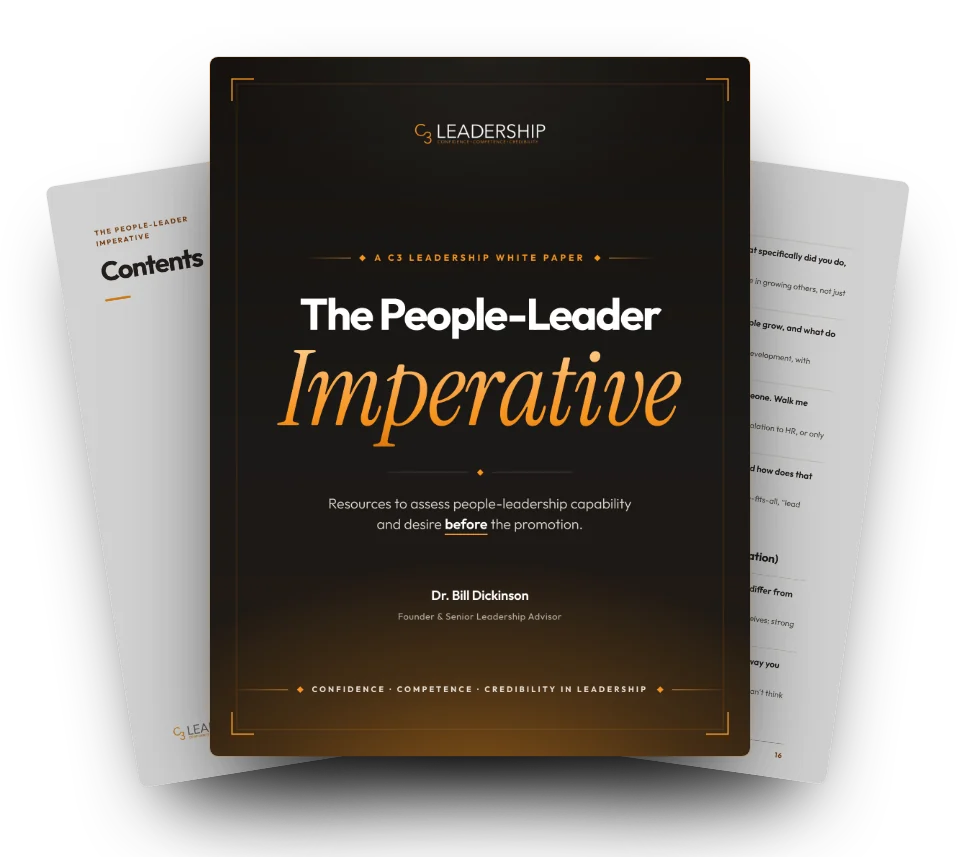
Get The People-Leader Imperative
The four capacities, the assessment toolkit, twelve interview questions and the EQ self-assessment, in one PDF sent to your inbox.
Something went wrong on our side. Email Bill.Dickinson@c3leadership.org and the white paper comes straight back.
Check your inbox
The white paper arrives in one email from Dr. Bill Dickinson. If nothing lands in a few minutes, look in spam.
We use your email to send you the white paper. See our privacy policy.




Leadership development and executive coaching. Based in Atlanta, working globally in virtual, in-person and hybrid formats.